Applies to the 2025 season results and the 2026 season ahead. CWD status changes constantly; verify the specifics with your state agency (links at the end).
How to read this guide
This piece comes in two parts, and you can stop after the first if that's all you need.
Part 1 — The Everyday Hunter's Guide is plain-language and practical: what chronic wasting disease is, whether it can hurt you, how to get a deer tested, what to do with the carcass, and where each of the five states stands right now. If you hunt or trap deer in Minnesota, Wisconsin, Michigan, North Dakota, or South Dakota, this part is written for you.
Part 2 — The Research is for readers who want the underlying science and the surveillance numbers: how prions work, what we actually know about the human-health question, and a state-by-state look at the data. It includes NomadPath's own Minnesota risk model put side by side with the published record — where it agrees, and where we're honest about its limits.
Both parts are free. We keep public-health and safety information like this out from behind any paywall, on purpose.
Part 1 — The Everyday Hunter's Guide
The short version: Chronic wasting disease, or CWD, is now confirmed in wild deer in all five Upper Midwest states. It is always fatal to the deer, elk, and moose it infects, and there is no cure or vaccine. It has never been shown to infect a person — but health officials are clear that you should not eat meat from an animal that tests positive or looks sick. In areas where CWD is found, the only way to know if your deer has it is to get it tested. Here's how to do that, and what to do next.
What CWD actually is
CWD is a disease of the nervous system caused by a misfolded protein called a prion. It affects members of the deer family — white-tailed deer, mule deer, elk, and moose. An infected animal slowly loses weight and coordination over months, may drool or drink and urinate more than usual, and eventually dies. There is no treatment. Once it takes hold in an area, it tends to stay.
The hard part for hunters: an infected deer usually looks completely healthy for most of the time it carries the disease. Most CWD-positive deer that wildlife agencies find were harvested by hunters who saw nothing wrong with the animal. You cannot tell by looking. Only a lab test can tell you.
Can it hurt me?
This is the question most hunters care about, so here is the honest answer.
There has never been a confirmed case of CWD in a human. The U.S. Centers for Disease Control and Prevention (CDC) says the disease has not been shown to infect people. That is the established fact, and it has held for decades.
But "no cases so far" is not the same as "proven safe," and the CDC does not treat it that way. Laboratory studies have produced mixed results, and some experiments in monkeys raised enough concern that public-health agencies recommend caution. Because a different animal prion disease — "mad cow" — did eventually cross to people, officials would rather hunters take simple precautions now than find out the hard way later.
What that caution looks like in practice:
- Do not eat meat from an animal that tests positive for CWD, or from any animal that looks sick.
- Get your deer tested if you hunt where CWD is known to occur. Important: the CWD test is a surveillance test, not a food-safety inspection — a "not detected" result is reassuring but not a guarantee.
- When field-dressing, minimize contact with the brain, spinal cord, eyes, spleen, and lymph nodes — the tissues where prions concentrate.
- Cooking does not destroy prions. You cannot make a positive animal safe by cooking it thoroughly.
None of this is cause for panic. It is the same kind of common-sense food handling hunters already practice, with a little extra care in the areas where the disease is present.
How to get your deer tested
Every state in this region offers free or low-cost CWD testing, and the systems are similar: you submit the animal's head (or specific lymph-node tissue) at a drop box, a self-service kiosk, or a staffed station, and you get results by mail or online a week or two later. Wisconsin, for example, reported an average turnaround of about nine days last season.
Where and how to submit depends entirely on your state and your hunting unit, and the locations change every year. The fastest route is your state agency's CWD page — all five are linked at the end of this guide. If you hunt inside a designated CWD management or surveillance zone, testing may be strongly encouraged or required, and your license materials will usually tell you.
What to do with the carcass
Prions can survive in the environment — in soil, on the landscape — for years, which is one of the main ways the disease spreads to new ground. That makes carcass disposal a real part of slowing it down. The shared guidance across all five states:
- Dispose of carcass waste in a landfill or through regular bagged trash — not by dumping it back on the landscape.
- Follow your state's carcass-transport rules. Most states restrict moving high-risk parts (brain, spinal column) out of a CWD zone or across state lines. Several provide carcass-disposal dumpsters during deer season.
- Watch for baiting and feeding bans. Where CWD is found, states often ban baiting and feeding, because piles of food concentrate deer nose-to-nose and accelerate spread. Wisconsin, for instance, imposes a multi-year baiting ban in any county with a positive — and in nearby counties when the detection is close to a county line.
Hunting Minnesota's firearms deer season? Pair this with our 2026 firearms deer guide for season-specific dates and zone maps.
Where the five states stand (2025 season)
A one-line read on each. The numbers reflect the most recent reported season and will move; treat them as a snapshot, not a scoreboard.
- Minnesota — Established in the southeast (the DNR's south-metro and southeastern management zones carry the highest detection rates), with a separate focal detection in the northwest near Crookston. NomadPath maps Minnesota's risk by deer permit area; see below.
- Wisconsin — The most heavily affected state in the region. The disease has been here since 2002 and is concentrated in the southern third of the state, where a meaningful share of tested deer come back positive. It keeps turning up in new ground — La Crosse and Clark counties recorded their first wild detections in 2025, and Oneida County in the north continues to add cases.
- Michigan — Found in 18 counties in wild deer as of early 2026, mostly across the southern and central Lower Peninsula, and spreading by roughly a county at a time — Gladwin was the most recent, and Genesee County near Flint was added in 2025.
- North Dakota — Lower overall numbers, concentrated in western and southwestern hunting units, with a newer detection pushing east near Grand Forks in 2025.
- South Dakota — Long-established in the Black Hills and western counties, now confirmed in roughly 19 counties and moving east of the Missouri River.
Before you go
NomadPath maps Minnesota's CWD risk by deer permit area — free, no account required — at nomadpath.net/minnesota/cwd. You can look up your permit area, see how its risk band is calculated, and read the exact data behind it. We built it because this is public-health information, and it should be free and clear, not buried.
If you'd like our read on CWD and season developments across the Upper Midwest as the agency data updates through the year, that's what our newsletter is for — one useful email, not a flood.
Subscribe to the NomadPath BriefThe rest of this guide goes deeper into the science and the numbers. If you came for the practical answer, you have it: know your zone, test your deer where it matters, handle the carcass responsibly, and don't eat a positive animal.
THE RESEARCH
The sections below use a more technical register and full sourcing. The honesty bar here is higher than in Part 1: we distinguish what the published literature establishes from what our own data merely suggests, and we state the limits of our model plainly.
The agent: why prions are different
CWD belongs to a family of diseases called transmissible spongiform encephalopathies (TSEs), caused not by a bacterium or virus but by a prion — a normal cellular protein that has misfolded into an infectious shape and induces other copies of the protein to misfold in turn. The CDC and state wildlife agencies describe the same core biology: prions concentrate in the central nervous system and lymphoid tissue, are not destroyed by normal cooking or standard disinfection, and resist environmental degradation.
That last property is what makes CWD so difficult to contain. Infected animals shed prions in saliva, blood, urine, and feces, contaminating soil, water, and forage. Those environmental prions remain infectious for years, so a landscape can transmit the disease even after infected animals are gone. South Dakota's Game, Fish and Parks has begun collecting soil samples in affected areas and testing them with RT-QuIC — currently the most sensitive prion-detection method available — specifically to measure this environmental reservoir in the Black Hills. Direct animal-to-animal contact and this environmental persistence together explain why the disease, once established, is regarded by every agency in the region as effectively permanent in an area.
The human-health question, in full
The practitioner summary above is accurate: no human case of CWD has ever been confirmed, and the CDC states the disease has not been shown to infect people. The fuller picture, which is why agencies counsel caution rather than reassurance:
A natural defense called the species barrier makes cross-species prion transmission inefficient. But that barrier is not absolute — bovine spongiform encephalopathy (BSE, "mad cow disease") crossed from cattle to humans as variant Creutzfeldt-Jakob Disease through the food supply, which is the precedent that keeps CWD under watch. Laboratory work on CWD's zoonotic potential has been genuinely mixed: the prion has experimentally infected squirrel monkeys and laboratory mice carrying human genes, and a study presented in 2017 reported transmission to macaques fed infected deer and elk tissue — including meat from animals that appeared healthy — though earlier macaque work had not shown transmission. Researchers also note that CWD exists as multiple strains, and different strains may differ in their ability to cross species barriers.
Because prion diseases can incubate for years to decades, the absence of detected human cases to date cannot rule out a low-level or long-latency risk that surveillance has not yet caught. The CDC therefore frames its guidance as precaution under uncertainty: avoid consuming positive or sick animals, have animals tested in affected areas, and limit handling of high-risk tissue. That is the responsible reading of the evidence — neither "it's been proven dangerous" nor "it's been proven safe."
The regional surveillance picture
The table below summarizes where each state stands. One caution before reading it as a scoreboard: sampling designs differ by state and year, so these figures are not directly comparable as prevalence rates. Wisconsin's high positive count reflects intensive, targeted sampling in known-affected zones; North Dakota's low count reflects a smaller, broader surveillance effort. Each cell shows what that agency most recently reported, not a like-for-like ranking.
| State | In wild deer since | Latest reported surveillance | Primary concentration | Recent / emerging detections (named by the agency) |
|---|---|---|---|---|
| Minnesota | 2010 (Olmsted County) | 120,000+ deer tested since 2002 (MN DNR) | Southeast (endemic); also managed near Bemidji, the Brainerd Lakes area, and the south metro | Northwest near Crookston/Climax along the Red River; Beltrami County (Bemidji) |
| Wisconsin | 2002 | 17,759 sampled, ~2,006 positive (2025 season) | Southern third — Vernon, Richland, Grant, Crawford counties | La Crosse and Clark counties (first wild detections); Oneida County (spreading north) |
| Michigan | 2015 | 148,000+ tested, ~376 positive (cumulative through early 2026) | Southern and central Lower Peninsula | Gladwin County (18th county, 2026); Genesee County/Flint (2025) |
| North Dakota | 2009 (unit 3F2, southwest) | 1,224 tested, 16 positive (2025 season) | Western and southwestern units (the 3A–3F complex) | Unit 2B near Grand Forks (eastern push); unit 3D2 |
| South Dakota | 2001 | Long-running Black Hills and statewide surveillance | Black Hills and western SD — Fall River, Custer, Pennington counties | ~19 counties confirmed; movement east of the Missouri River |
Wisconsin is the region's epicenter and its longest-running case study. CWD was first detected in Wisconsin's wild herd in 2002, and the state has now sampled more than 334,000 deer over two-plus decades. For the 2025 CWD year (April 1, 2025–March 31, 2026), the Wisconsin DNR reported roughly 17,759 deer sampled with about 2,006 positives — and crucially, that positivity reflects targeted sampling, not a random statewide rate. The disease is concentrated in the Southern Farmland Zone (Vernon, Richland, Grant, and Crawford counties among them), which accounted for roughly 87% of 2025 positives. The leading edge keeps advancing: La Crosse and Clark counties recorded first wild detections, and Oneida County in the north continued to accumulate cases. Wisconsin's management response — statutory three-year county baiting and feeding bans triggered by a positive, extended to adjacent counties within ten miles of the detection — is the most aggressive regulatory posture in the region.
Michigan first found CWD in wild deer in 2015 (captive-cervid and broader surveillance dates to 2002). As of early 2026 the disease had been confirmed in 18 counties, predominantly across the southern and central Lower Peninsula, with Gladwin County the most recent addition. Cumulatively, Michigan has tested more than 148,000 deer and identified on the order of 376 positives. Because hunter participation in testing is largely voluntary, agency biologists are explicit that the true prevalence is almost certainly higher than the confirmed count, and they point to high deer densities and bait-pile concentration as accelerants.
North Dakota sits at lower absolute numbers but a widening footprint. The state's first wild case was a mule deer in unit 3F2 in the southwest in 2009. In the 2025 sampling season the Game and Fish Department tested 1,224 animals and confirmed 16 positives, all hunter-harvested, drawn mostly from western and southwestern units (the 3A–3F unit complex) and including first-ever detections in units 2B (near Grand Forks, in the east) and 3D2. North Dakota sets CWD regulations annually by proclamation and restricts transport of high-risk carcass parts.
South Dakota has one of the region's oldest footholds, with its first wild detection in white-tailed deer in 2001 and a concentration in the Black Hills and western counties (Fall River, Custer, Pennington) that now reaches roughly 19 counties, including movement east of the Missouri River. The state's 2025–2029 CWD Action Plan funds a multi-year Black Hills elk survival study — over 200 GPS-collared females, with more added through the winter of 2025–2026 — alongside the soil-prion (RT-QuIC) work noted above, reflecting particular concern over prevalence in the Wind Cave and Custer State Park elk herds.
Nationally, CWD has now been documented in wild cervids in more than 35 states, per tracking compiled by the CWD Alliance and the USGS National Wildlife Health Center, which maintains the authoritative U.S. distribution map.
Our data: the Minnesota risk model
This is where NomadPath adds something to the public record, and where we are most careful about scope.
What it is. NomadPath maintains a per–deer-permit-area (DPA) CWD risk model for Minnesota, built directly on the Minnesota DNR's published sampling data. It assigns each of Minnesota's 133 DPAs one of five risk bands, computed over a rolling three-year window of samples and positives:
| Risk band | Threshold (3-year window) | What it means |
|---|---|---|
| insufficient sampling | fewer than 100 samples | Too little testing to judge — not the same as "clean" |
| no detection | ≥ 100 samples, 0 positives | Well-tested, none found |
| low | positive rate below 0.3% | Detected at a low rate |
| elevated | 0.3% up to 1.0% | Established presence |
| high | 1.0% or greater | Highest detection rates in the state |
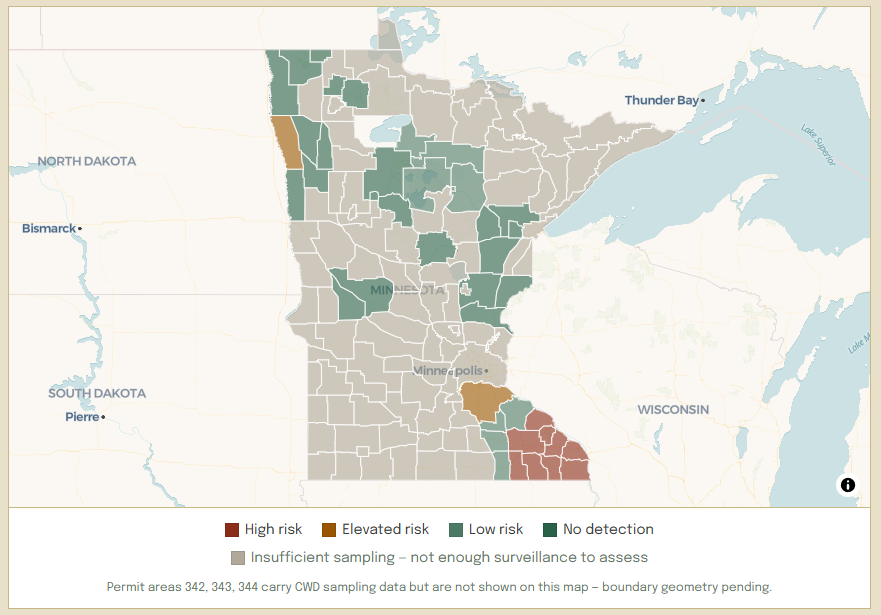
What it shows. Two geographic signals dominate, and both line up with the DNR's own record. The primary concentration is the southeastern Minnesota management-zone cluster — the Fillmore/Houston/Winona/Olmsted corner where the disease became endemic after detections began in 2010 — which carries the highest established positive rates in the state. A second, smaller focal signal sits in the northwest near Crookston and Climax, along the Red River; this matches the agency's first border-area detections in that region and is exactly the kind of signal that matters because it sits apart from the main front. The DNR is also actively managing detections near Bemidji (Beltrami County), the Brainerd Lakes area, and the south metro. Current per-DPA bands are published live and free at nomadpath.net/minnesota/cwd, where you can also see each agency detection map and the national USGS distribution map linked for context.
Where our data sits relative to the literature. Our model does not establish anything new about CWD biology; it organizes an existing agency dataset into a transparent, decision-ready form. Its value is methodological honesty rather than novel science: we publish the exact band thresholds, we keep a 100-sample floor so that low-effort areas read as insufficient sampling rather than as falsely reassuring no detection, and we preserve the distinction between "tested clean" and "barely tested" that a simpler two-color map would erase.
Its limits, stated plainly. First, the model is Minnesota-only — we do not currently publish a comparable risk model for Wisconsin, Michigan, North Dakota, or South Dakota, and nothing in this article should be read as implying we do; those states' figures above come entirely from their own agencies. Second, the model inherits every limitation of the underlying surveillance: it reflects sampling effort as much as true prevalence, so a quiet DPA may be quiet because it is under-tested, not because it is disease-free — which is exactly why our weakest band is labeled honestly. Third, it is a rolling snapshot that updates as the DNR publishes; the live tool carries its own "data current as of" date, and that date, not this article, is authoritative.
Our read, clearly labeled as interpretation rather than established fact: given prions' environmental persistence and the documented pattern of slow, county-by-county advance everywhere else in the region, we would expect Minnesota's two clusters to broaden gradually rather than stay fixed, and we'd expect newly sampled DPAs near the southeast front to be the most likely to move out of no detection. If that's right, the practical implication for hunters is to test even in areas that read clean today. If it's wrong, the more likely explanation is that Minnesota's management-zone strategy is containing the front better than the regional pattern would predict — a genuinely good outcome we'd be glad to be corrected by. We'll revisit this read as the data comes in.
Bottom line
CWD is established and slowly expanding across the entire Upper Midwest. It remains, on the current evidence, an animal-health and herd-management crisis rather than a demonstrated human-health one — but the precautionary guidance exists for sound reasons, and it costs a hunter very little to follow. The most useful things you can do are unchanged by any of the science above: test your deer where the disease is present, handle and dispose of carcasses responsibly, and don't eat an animal that tests positive or looks sick.
For Minnesota, you can see your permit area's risk and the data behind it, free, at nomadpath.net/minnesota/cwd. For the most current status and the regulations that apply to your hunt this season, go straight to your state agency below — CWD rules change every year, and the agency is always the authority.
See your permit area's risk and the data behind it, free.
Open the Minnesota CWD MapVerify with your agency
CWD status, testing locations, and carcass regulations change annually. Always confirm with the source before your season:
- Minnesota DNR — CWD: dnr.state.mn.us/cwd
- Wisconsin DNR — CWD: dnr.wisconsin.gov/topic/wildlifehabitat/cwd
- Michigan DNR — CWD: michigan.gov/cwd
- North Dakota Game & Fish — CWD: gf.nd.gov/wildlife/diseases/cwd
- South Dakota GFP — CWD: gfp.sd.gov/chronic-wasting-disease
Federal / national references:
- CDC — Chronic Wasting Disease: cdc.gov/chronic-wasting
- USGS National Wildlife Health Center — CWD distribution map: usgs.gov/centers/nwhc
- CWD Alliance: cwd-info.org
NomadPath synthesizes public agency data into clear, sourced decisions for hunters and anglers across the Upper Midwest. We keep public-health and safety data free. Accuracy over hype: where the data isn't in, we say so.